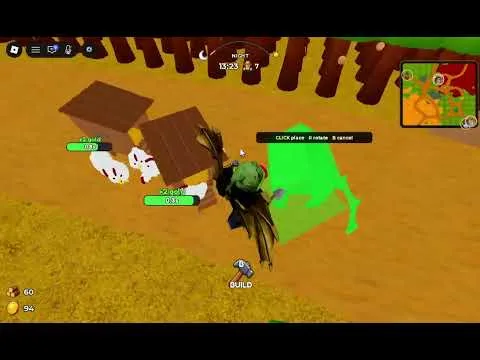
The Farmer is the builder and the banker. The official job is to chop, build, defend, collect, and last until morning. You also win if the Beast dies to the base. A developed fort is what Beast players call unbeatable, so the opening exists to reach that state before night.
Opening order
- Chop the nearest trees. Wood pays for the shelter and most early structures, and chopping can drop coins as well.
- Commit to one area. One player deliberately takes a corner so the Beast has fewer approaches.
- Put the shelter up before the hunt is active.
- Place a chicken farm. One run spent exactly 10 wood and watched chickens drop gold. Another coop was bought from a starting balance of 100 and paid about 1 gold every 3 seconds. A different session described the same farm as 1 gold per second. Use the price tag in your menu.
- Leave an emergency gap about two blocks wide. If the Beast blocks the front door, that gap is the exit it is not standing on.
A Lumberjack report changes only the chopping math: 3 wood instead of 2, and 25 percent faster chops at max level. The damage sprint does not belong to that class. After the Beast hits you, every player in that report sprinted without spending stamina, and stamina even regenerated during the sprint. Use the burst to put a fence between you and the hunter.
What you place
Structures come from the build menu and are paid in wood, gold, or both. Rotate them before you confirm. Recorded pieces:
- Shelter, the core you want up early.
- Fences, placed right after the shelter.
- Wood, stone, spiked, and metal walls. Wooden and golden gates open and close. Iron and metal sections that do not open can lock you inside your own base.
- Workbench, the research station. The upgrade list itself is not documented.
- Turrets, ballistas, and land mines. A turret cost about 300 in one match. A mine works once.
- Watchtowers. Decorations such as flags, scarecrows, fountains, and statues do not defend you.
The Beast breaks farms, fences, and towers. Re-chopping and replacing pieces is normal. No recording shows a repair button, so do not plan on fixing a wall in place.
Gold after the first coop
Once a fence exists, stop stacking only the cheapest farms and save for a pig, cow, or bee farm. Those are the ones players say scale income faster. A cow farm took 40 wood in one run. Full payout examples, including conflicts, are in the farm economy guide.
While you are outside, the Beast can reach you far from base. Footsteps and panting are the usual warning. One player's rule is to go quiet when he thinks the hunter is close. At night, stop expanding: finish the shelter, close the lines you mean to close, and work the gates.
Eating an apple restored one player to full health. That is a single match, not a food system guide. Farms in recorded rounds kept producing after their owner was gone. Dying is not always the end of the round, but the exact catch rule is unconfirmed. See how a catch works.
One base, not five
The strongest Farmer upgrade in the recordings is teammates on the same plot. Construction is faster and the gun line is shared. Players walk through each other's houses and ask to farm inside a neighbor's walls. Direct wood or gold trading is not shown in some sessions and is shown as donated wood and statues in another, so do not rely on a trade button. Cooperation that is consistent is shared construction and joint defense.
Layered guns do real damage. Beast players report losing roughly 100 to 300 health on a push into ballistas, turrets, and fences. Rounds end with turret lines killing the Beast, or with the Beast refusing a last push because the guns cost more health than the clock allows. If the Beast gets in, the fallback is a second wall plus the escape gap so it funnels into the turrets while you leave.
Next: build the first base, place the defenses, or hold until sunrise.